
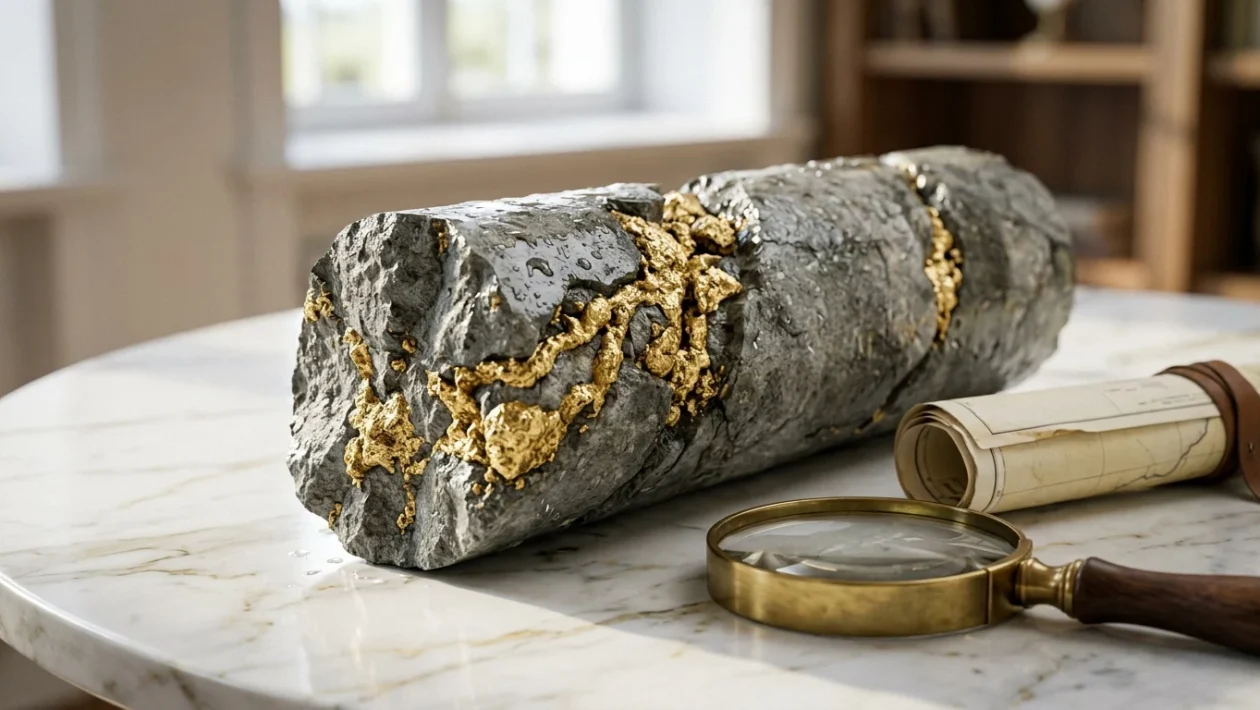
Geological rock core samples showing visible gold veins extracted from a deep underground mine in China.
A Deposit That Could Reshape the Market
Deep beneath the mountainous terrain of central China, geologists have made a discovery that is sending shockwaves through the global mining industry.
Exploration teams confirmed a colossal gold deposit in the Wangu field, located in Pingjiang County within Hunan province. Preliminary estimates indicate the site holds over 1,000 metric tons of the precious metal.
If these projections are fully realized, the Wangu field will rank among the largest gold discoveries of the modern era. Experts currently value the underground deposit at approximately 600 billion yuan, or roughly $86 billion.
Exceptional Grades and Visible Gold
The provincial Geological Office has already identified more than 40 distinct gold veins at depths approaching 2,000 meters. These verified upper layers contain roughly 300 metric tons of confirmed gold.
Using advanced three-dimensional geological modeling, specialists project the total reserves will easily surpass the 1,000-ton mark once exploration drilling reaches a depth of 3,000 meters.
What stunned researchers most was the presence of visible gold in the extracted rock cores—an absolute rarity in contemporary mining operations. Some geological samples yielded staggering concentrations of up to 138 grams per ton, an exceptionally high grade by stringent international standards.
Historical Comparisons and Industry Caution
Industry insiders are already labeling the find a “supergiant.” Many are drawing direct comparisons to South Africa’s historic South Deep mine, long considered one of the world’s most critical gold reserves.
However, experts from the World Gold Council are urging restraint. They note that only the shallower layers of the deposit have been rigorously verified through physical extraction.
The deeper projections rely entirely on computer modeling. Determining the ultimate scale of the Wangu deposit will require extensive future drilling campaigns and sustained, heavy capital investment.
Economic Boom vs. Environmental Reality
The economic benefits for China—which already leads the world in gold production—are undeniable. The project promises a massive influx of jobs, rapid infrastructure development, and a surge in national mineral output.
Yet, the discovery presents severe environmental hurdles. Extracting gold from extreme depths demands colossal energy consumption and generates massive volumes of industrial waste.
The extraction process also carries a high risk of releasing heavy metals and toxic pollutants into surrounding ecosystems. As global pressure mounts to combat the climate crisis, the Wangu deposit will serve as a critical test for the viability and execution of large-scale “green mining” initiatives.


